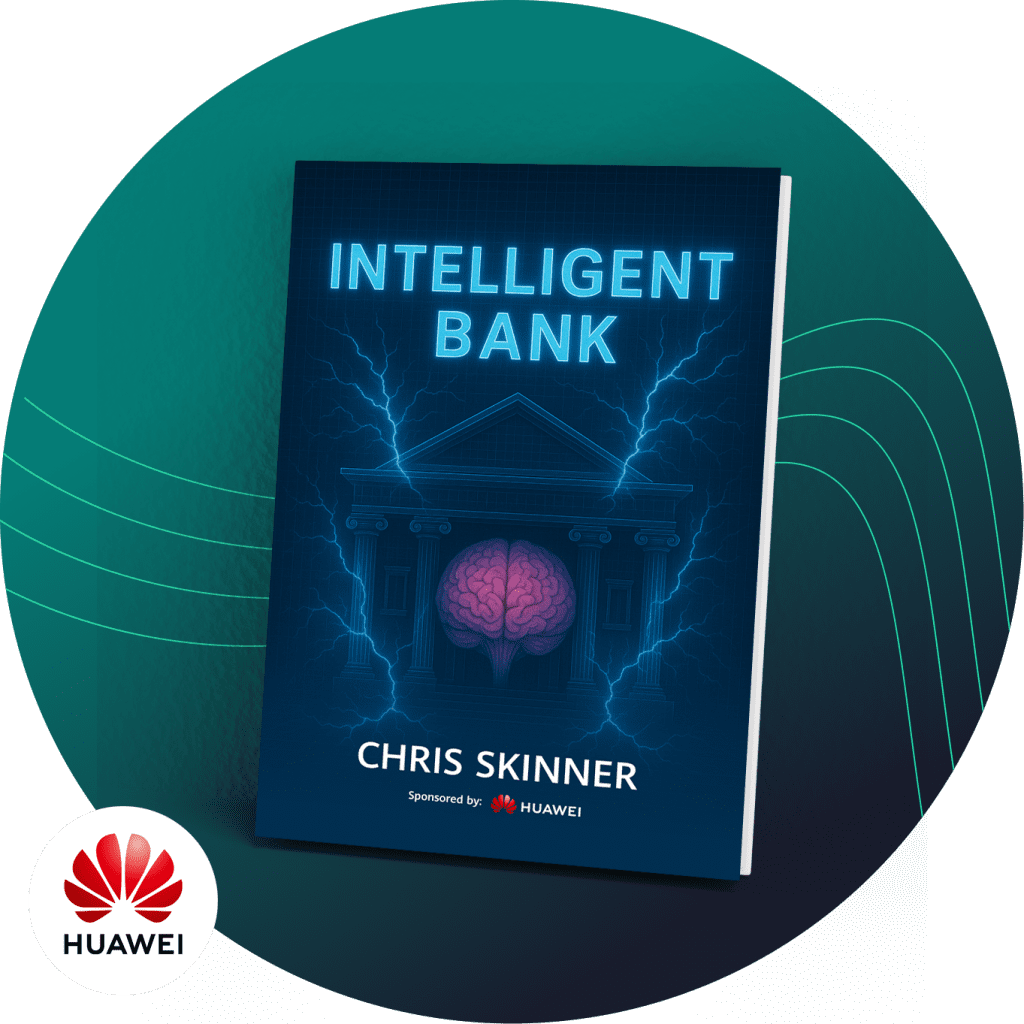
INTELLIGENT
BANK By Chris Skinner
Intelligent Bank is not a book about technology alone. It is a warning and a roadmap. Banks that fail to move from digital to intelligent will not survive—not because they lack apps or AI, but because they fail to earn trust in an autonomous, AI-driven world.

Foreword
The Era of the
Intelligent Bank
The banking industry is at a pivotal point. For decades, “digital transformation” largely meant moving from paper to pixels — turning branch processes into web portals and mobile apps. But as Chris argues in this book, being “digital” is no longer the differentiator. What matters next is intelligence: the ability to connect data, decisions, and customer experiences into a coherent, continuously learning system.
This is not a futuristic fantasy — it is becoming an operational necessity. Across the industry, we see the same tension every day: banks carry deep legacy complexity, yet they also sit on immense potential. This book helps bridge that gap by offering a clear, actionable view of what an Intelligent Bank really is.
An intelligent bank is not a collection of disconnected silos. It is a unified organization with consolidated data and integrated systems that can turn signals into decisions — quickly, consistently, and responsibly. It moves beyond transactional product pushing toward a deeper understanding of customer context and intent. By continuously sensing and analyzing real-time data from various sources — whether through car dashboards, voice assistants, or wearable devices — the bank becomes an intelligent assistant, providing personalized financial services anytime, anywhere, in the flow of a customer’s daily life.
I am particularly aligned with Chris’s focus on anticipatory banking. In an era of instant expectations, the institution that waits to be asked is often already too late. True intelligence lies in serving customers proactively — while keeping people “in the loop” to provide judgment, accountability, and trust. This human element is central to the next phase of banking: using intelligent systems to augment expertise and accelerate learning without losing control of the decisions that matter.
At Huawei Digital Finance, we work with banks to provide the technological backbone and strategic expertise needed to turn principles like those in these chapters into competitive reality. I hope this book offers you practical insight, useful frameworks, and the confidence to take the next step on the journey toward the Intelligent Bank.

Jason Cao
CEO, Huawei Digital Finance
Endorsements of
Chris’s books


A frighteningly accurate dose of reality and vision that needs careful reading.
Nick Ogden
The inventor of e-commerce

For anyone wondering what’s next in the world of finance, this book shines a light on the latest thinking.
Anne Boden
Founder and former CEO of Starling Bank

The world of Intelligent Money is not utopian. It is not very neat or particularly pretty. But it is customer-led, exciting and optimistic.
Tony Craddock
Director General, The Payments Association

You had me at Lego Bank, Darth Vader, and George Orwell!
Theo Lau
Author of The Metaverse Economy

Chris Skinner masterfully navigates the complex waters of digital banking.
Jason Bates
Co-founder, Monzo

Filled with thought provoking information on AI applications in FinTech.
Jill Castilla
President and CEO, Citizens Bank of Edmond

This is a f***ing excellent book
Uzoma Dozie
Founder of Sparkle and former CEO of Diamond Bank

Skinner’s vision of a more intelligent approach to money is inspiring and practical, making this book a must-read for anyone seeking to thrive in the financial world of tomorrow. Recommended. Full review here.
Monty Munford
Technology journalist
The Core Thesis
Banking’s Third Great
Technological Revolution
Every generation, banking is remade by a new technological paradigm. We are now entering the third — and it demands more than incremental change.
01
1960s – 1990s
The Mainframe Era
Automation and scale. Banks computerised their back offices, eliminated paper, and built the infrastructure of modern finance.
02
2000s – 2020s
The Digital Era
Connectivity, mobile, fintech, and experience. Branches gave way to apps. APIs enabled ecosystems. Digital solved distribution — but not understanding.
03
2025 → Future
The Intelligence Era
AI-driven insight, prediction, and delegated decision-making. Banks must now transform data into knowledge, knowledge into insight, and insight into real-time action.
Inside the Book
From Digital Bank to Intelligent Bank
What digital achieved — and why it’s incomplete. Despite huge investment, most banks still lack a true, real-time customer view.
Defining the Intelligent Bank
Fully consolidated data, AI-driven understanding, anticipating needs rather than reacting to requests, consistent delivery across all touchpoints.
The Intelligence Revolution
Beyond GenAI and Agentic AI headlines — intelligence is about insight, pattern recognition, prediction, and orchestration. Not content generation.
Humans and Machines
How roles evolve when AI becomes a collaborator. New positions emerge as old ones disappear. The rise of judgement, ethics, and emotional intelligence.
Customer Experience Reimagined
Finance as life enablement, not transactions. Micro-level balance sheet optimisation. Targeted capability acquisition over bulk growth.
Crime, Fraud & Systemic Fragility
Deepfakes, AI-driven fraud, crypto and illicit finance. IT failures as systemic risk — banks as “digital Jenga towers.” How fragile modern finance really is.
The Trust Architecture
Rebuilding trust through Zero Trust systems, Zero-Knowledge Proofs, and token-based identity. Trust designed in, not added as an afterthought.
The Future Bank & Long-Term Outlook
Invisible but omnipresent. Embedded in daily life. The implications of quantum computing, Big Tech, crypto, and global power shifts through 2100.

About Chris Skinner
Chris Skinner is known as one of the most influential people in technology and an independent commentator on the financial markets and fintech through his blog, thefinanser.com. He has written eighteen books about finance and technology, with bestselling books including the series Digital Bank, Digital Human, Doing Digital and Digital for Good.
He has been recognised as one of the most influential figures in finance, fintech, technology and payments, receiving a lifetime achievement award from the UK payments association in 2023. This is why he has been an advisor to the United Nations, the White House, the World Bank and the World Economic Forum, as well as governments and firms across the world.
Chris is also a successful children’s author with the five-book series about Captain Cake and the Candy Crew.